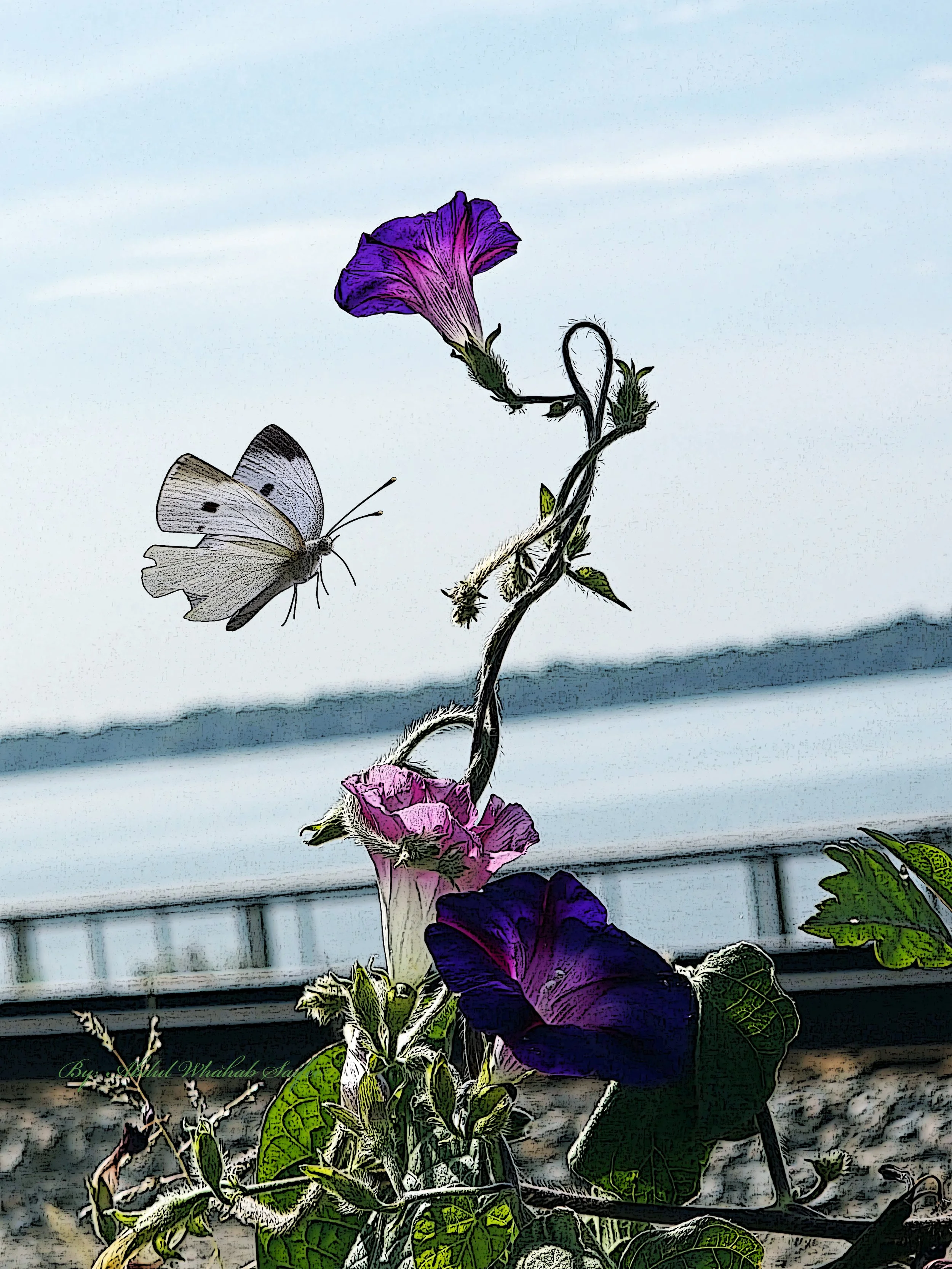
Reaching the Light 08-21-2026 1052 AM
Along the northern shores of Lake Minnetonka, where no two days seem quite alike—perhaps not even two hours—it was the composition that first caught my attention, even before the color. High above the dense growth below was one of the smallest morning glories I had seen, catching the morning light in its full glory against an enormous sky, overlooking the waters below.
Yet it was not the blossom alone that caused me to remain.
Immediately beneath it, the stem had turned upon itself and formed an almost perfect circle, resting there at the foot of that tiny flower as though the long twisting journey below had somehow arrived at precisely the place where it needed to be.
Had that circle not been there, I might easily have dismissed the scene after taking a quick photograph. There would have been a picture, perhaps even a beautiful picture, and certainly there could have been a caption beneath it—but there would have been little of the story, and perhaps none of its message.
The circle caused me to stay, and because I stayed, I began to see.
The morning glory itself was extraordinarily small. Its smallness was part of what made the composition so remarkable, because something so delicate had somehow reached so high, almost as though it had climbed for a greater view of Lake Minnetonka.
But it was not alone.
As I looked more closely, I discovered three. Another, very much like it but somewhat larger, remained near the bottom of the stem, while a third had come from a different shoot. They seemed, each in their own way, to have discovered the same opportunity: an older stem, twisted upon itself and hardened with time, had become something upon which younger growth could rise.
And the smallest had gone farthest.
Admiration was becoming observation, and observation was becoming a question.
What had happened here?
The old stem was not dead, but I saw no flower upon it, nor did I see buds waiting to open along that hardened stretch. It had become rigid, twisting and turning upon itself until it stood almost like a column.
I cannot say what flower it may once have carried, because I was not there to see it, and I do not want to give nature a history merely because it would make the story convenient. I can only tell what stood before me.
And what stood before me had become support.
It was almost as though a decision had been made long ago, before I ever arrived with my camera, that this part would become the column, the structure upon which younger shoots could take hold and continue their climb. The plant did not make such a decision in the human sense, yet hidden within its living essence was an inheritance, instructions we speak of scientifically as DNA, carrying possibilities for growth, response, adaptation, continuation.
The stem did not write those instructions for itself.
They had been given long before the morning when I arrived with my camera.
And what fascinated me was what happened when those invisible instructions met the circumstances before them.
There was nothing obvious above for the stem to grip, yet the reaching did not simply end. The stem turned upon itself, circled, hardened and became its own support; and in becoming its own support, it became support for something else.
In the language of faith, I could not help seeing something more in this. It appeared almost as though the stem had yielded to a wisdom older than itself, accepting what had been entrusted within its nature and becoming what the circumstances required of it.
The younger shoots found it.
One climbed here, another approached from elsewhere, and the smallest morning glory traveled farthest until there it was above them all, opening into the morning light.
The old stem did not carry a flower that I could see.
It carried what carried the flowers.
That distinction changed everything for me.
Its contribution was not something beautiful at its own tip immediately asking to be admired. Its contribution had become structural—quiet, rigid, hardened, almost easily overlooked. It had become a column, perhaps even a bridge, and now, because of that remarkable circle immediately beneath the blossom, it appeared almost as though the old stem wore the morning glory as a crown.
Yet even that crown was not really for itself.
It was carrying something beyond itself into the light.
I had never quite seen beauty this way before.
We often think of beauty as the flower itself—the thing in full bloom, opened completely, receiving the sunlight and drawing our eyes toward it. Yet the flower in its full glory carries within its nature the certainty that it cannot remain in that form forever. What is open will close, what is large will become small, what is brilliant will fade, and the form through which beauty appears today cannot remain forever.
But perhaps giving does not end when one form of beauty ends.
Perhaps purpose can change its form.
The old stem beneath the blossom seemed to suggest precisely that. It did not need to become the flower; it had become what the flower could hold onto.
And then the photograph began asking questions larger than the plant.
What do we do when we must reach the light and there is nothing above us to grip? What do we do with what has bent us, with what has hardened us, with what has hurt us? What do we do when the journey carries us somewhere we could never have imagined when we began?
Because when a person begins a journey, he does not know what will happen in the next hour, much less the next day, the next week, the next year, or the many years that may follow.
We begin without knowing.
We reach, encounter, change direction, endure, discover, and sometimes only years later begin to understand what a particular part of the journey was preparing us to become.
Perhaps this is where the old stem began speaking to me most personally, because its hidden inheritance made me wonder about our own.
How much of a human life remains hidden even from the person living it?
We begin our journeys without knowing all the gifts we carry. Courage may remain invisible until something frightens us. Compassion may remain hidden until another person's suffering calls it forward. A teacher may live quietly within someone until another human being needs guidance. A writer may carry stories for half a lifetime before discovering the language with which to tell them. A photographer may preserve a moment without knowing that nearly a decade later it will find its place inside another image and help tell another story.
There may be capacities within us that cannot become visible until life asks something of them.
There may be gifts whose purpose we misunderstand because their season has not yet arrived.
There may be something entrusted to us whose usefulness will not become apparent for years.
The invisible does not necessarily mean the absent. Sometimes it means not yet revealed.
The flower was hidden before there was a bud.
The butterfly photograph was hidden on an old SD card.
The meaning of the stem was hidden inside the composition.
And perhaps some of the most meaningful possibilities within a human being remain hidden until the circumstances of life call them into the light.
This, however, brings us to something nature cannot decide for us.
What will we do with what has been entrusted to us?
Strength can become domination, or strength can become support. Intelligence can humiliate, or intelligence can teach. Authority can elevate the self, or it can protect someone vulnerable. Memory can preserve resentment, or memory can become warning and wisdom. Pain can become permission to inflict another wound, or pain can deepen our compassion for someone whose suffering resembles our own.
A gift does not reveal its fullest meaning merely because we possess it.
Its meaning is revealed through what we do with it.
And suddenly the old stem seemed to answer the questions I had been carrying:
Become support.
A helping hand.
There is a difference between surviving suffering and transforming suffering. Survival can say, I endured. Transformation can say, Because I endured, perhaps someone else will have something to hold onto.
The old stem had been bent, but it did not bend the younger shoot. It had become hardened, but its hardness became strength for something tender. What looked like limitation had become usefulness; what looked like an ending had become structure; what had turned upon itself had become a place from which another life could rise.
And suddenly the lesson was no longer about one stem.
It was about a person.
But it could not stop with one person.
It was about a family, but it could not stop with a family. It was about a tribe, a village, a region, a country, and finally humanity itself, because deep inside this image is a lesson about sacrifice and about what becomes possible when sacrifice does not end with the one who makes it.
Human history has known men and women willing to become bridges so that others might cross. Some surrendered comfort, some surrendered position, some surrendered years, some surrendered safety, and some surrendered their very lives so that people they might never meet could inherit something better.
They did not always reach the destination themselves.
Sometimes their contribution was becoming the road.
Sometimes the bridge.
Sometimes the column.
Sometimes the helping hand.
The younger generation reaching farther does not necessarily diminish those who carried it. Perhaps reaching farther is the fulfillment of what they carried.
The smallest flower reached the highest point, but when I followed its journey downward, I discovered that its height belonged to more than itself.
There is something here for parents and children, husbands and wives, brothers and sisters, friends and strangers. Hurt has a way of traveling, and a person who suffers can sometimes, without intending to, pass that suffering onward. Pain can travel through a family and into another generation; a tribe can carry an old injury against another tribe; a nation can carry memory until memory itself becomes another reason to wound.
Humanity can inherit yesterday's suffering and make it tomorrow's suffering.
But suffering does not have to reproduce itself.
The wound does not have to become the weapon.
Pain can become understanding. Experience can become wisdom. Hardness can become strength. Memory can become warning. Suffering can become compassion, and what once hurt us can sometimes become the very reason we refuse to hurt another.
I was hurt—but I do not have to hurt you. I was bent—but I do not have to bend you. I became hardened by what I endured—but I can use that strength to hold you. I may not be the flower—but perhaps I can help you reach the place where you can flower.
Perhaps that is what a family can do for another family, what a village can do for another village, what one people can do for another people, and perhaps even what nations might someday learn to do for one another.
If the common goal is to reach the light, why should we spend our strength pulling one another downward?
We have not all been given the same gifts, nor should we have been. Each of us arrives carrying different possibilities, different abilities, different histories and different ways of contributing. One becomes support, another climbs, another flowers, another flies, another observes, another remembers, another teaches, another carries, and another tells the story.
Difference does not have to become division.
Difference can become cooperation.
Even the human body teaches us this. Its parts are not valuable because they are identical; they are valuable because their different abilities serve something larger than themselves. Perhaps humanity is also engaged in such a collective journey—a human body in search of truth, slowly discovering that none of its parts possesses the whole by itself.
Perhaps, then, part of becoming fully human is discovering what has been entrusted to us and deciding how it will be used.
A family inherits both gifts and wounds. What will it pass forward?
A people inherit language, culture, memory, knowledge, beauty, accomplishment, and sometimes terrible suffering. What will they make from that inheritance?
A nation inherits institutions, resources, power, history and responsibility. How will those gifts be used?
Humanity itself inherits the accumulated discoveries, mistakes, sacrifices and wisdom of countless generations. Will we use that inheritance merely to climb higher than one another, or will greater knowledge make us increasingly capable of helping one another rise?
The invisible truth becomes visible every day.
Perhaps truth has always been speaking.
Perhaps we have not always remained long enough to hear it.
And then there is the butterfly.
The butterfly was not beside that morning glory when I made the photograph at Lake Minnetonka. It came from another time, nearly a decade earlier, when I photographed a small cabbage butterfly whose wings were damaged. I remembered making the photograph, but among thousands of files I no longer knew where it was.
Meanwhile, an old SD card had been sitting among my things for several years. Recently I picked it up, intending to format it for use in my camera, but the camera would not format it. I checked whether the card was locked; it was not. Perhaps, I thought, it was simply an older and much slower card that my camera did not particularly like.
For whatever reason, I did not force the matter.
I left it unformatted.
Later, before doing anything further with it, I decided to look carefully at what was actually there.
And behold.
There were photographs.
The card I had almost treated as something empty, something ready to be erased, had quietly preserved a much-needed backup of some of my better photographs.
And among them was the butterfly I remembered.
There it was, broken wings and all, still making its way.
Nearly a decade separated the butterfly from the morning glory. They had never occupied the same afternoon or shared the same patch of earth, yet now that wounded butterfly found its way to this place and this time.
I did not need to invent its wounded wings; they were already there. I did not need to invent the twisted stem; it was already there.
One had lost part of its wings and continued to fly.
The other had bent and hardened and become support.
And somehow, separated by years, they arrived together in one image.
There was even another quiet correspondence I could easily have missed. The young flower had found usefulness in an old stem; I had found usefulness in an old SD card; and this new photograph had found something it needed in an old photograph.
What might easily have been dismissed because its first purpose seemed to belong to another time had become important again.
Perhaps usefulness does not always end when one season ends.
Perhaps sometimes it waits.
This is one of the things photography continues to teach me. A shutter may open and close in a fraction of a second, yet seeing the photograph can take years.
And this photograph itself almost became merely another shutter click. Had that circle not caught my attention at the foot of the morning glory, perhaps I would have taken the picture and moved on. There would have been a photograph, but little of the story, and perhaps none of its message.
Nothing in that stem changed while I studied it.
What changed was the depth of my seeing.
First there was composition, then color, then the smallest morning glory and the circle beneath it. Then I discovered that the little flower was not alone. I saw the old stem, its twisting and rigidity, the absence of flowers and buds upon that hardened stretch, and then the younger shoots using it. Later came the memory of the wounded butterfly, and then an old SD card that had almost been erased.
Admiration became curiosity; curiosity became observation; observation became questions; and questions, perhaps, became learning.
Something invisible had been standing plainly before me.
I simply had not remained long enough to read it.
And somewhere beneath all these thoughts, another memory returned to me—one belonging not to the photograph itself, but to my own spiritual journey. It came to me in a dream, in response to a prayer, and the message I remember was:
“Consider my presence in this world like a flower. Gather around me.”
Those words have remained with me, and now, standing before this image, I hear them again.
I think of the voice that still echoes through the valleys He walked and the villages He visited; the One I know through the ancient names and testimony of Scripture—the Son of Man, the Author of Life, Mighty God, Everlasting Father, Prince of Peace.
And I look again at that little flower.
Gather around—not to climb over one another, not to destroy one another in the struggle to reach it, and not to imagine that another person's reaching somehow diminishes our own, but perhaps to discover that we have been given different gifts because the journey was never intended to be made entirely alone.
What would happen if the question were no longer merely, How can I reach the light? but also:
Whom can I help reach it?
What if a person asked that question? What if a family asked it? What if a village, a tribe, a region, or a country asked it? What if humanity asked it?
Perhaps peace begins somewhere inside that change of question—not How can I climb over you? but How can I become something you can hold onto?
There have always been people willing to make that choice—to become a bridge so another could cross, a column so another could rise, a shelter so another could survive, a teacher so another could understand, or a sacrifice so another might live.
The greatest among them did not necessarily become the flower everyone admired.
Some became the stem beneath it.
And somewhere in all of this, I began to see another resemblance.
The author himself resembles that old stem.
Not because his flowering is finished, for neither the stem nor the author knows what a few days may bring. Today there may appear to be nothing. A few days later there may be a bud, and after that perhaps a flower overlooking the waters below, catching the morning light as though it had climbed all that way to say:
I have come to tell a story.
And I have done that.
It took a lifetime. Much was lost along the way, but hope remains.
The invisible part of our existence becomes visible through the stories we tell, the discoveries we make, the photographs we preserve, and the psalms we write when ordinary language is no longer enough. What lived silently within us for years can finally take form, and what took a lifetime to understand may become a small place for another human being to take hold.
Perhaps the author, too, carries gifts that even now remain undiscovered.
Perhaps all of us do.
There may be stories still without words, compassion still waiting for the person who will need it, courage awaiting its hour, wisdom not yet called upon, and possibilities whose purpose will not become visible until years from now.
The invisible does not necessarily mean the absent.
Sometimes it means not yet revealed.
Neither the stem nor the author could have known, when the journey began, what the next hour would bring, much less the next day, the next year, or the many years that would follow; yet both, having climbed through what was given to them, seem now to call others to climb as well—not by climbing over one another or pushing another life downward in order to gain greater height, but by discovering how our different gifts, experiences, sacrifices, and even some of our wounds can become part of the support by which another person rises.
What happens from here neither the stem nor the author can know, and perhaps that uncertainty should remain exactly where it belongs, in the unwritten pages ahead. What remains, however, is hope: hope for another discovery, another bud appearing where yesterday there seemed to be none, another flower opening to the morning light, and another human being discovering a better way after reading from those extraordinary pages of nature that have been open before us all along.
There is also a different kind of joy in recognizing that the blossom was never the achievement of the blossom alone. The old stem became support, the younger shoot recognized the opportunity and climbed, the roots continued their hidden work beneath the earth, the morning light arrived, and eventually the little flower opened above the waters of Lake Minnetonka.
Each contributed differently, yet together they made the flowering possible.
Perhaps there is something here that humanity, so often divided by the very differences that might have helped us, desperately needs to rediscover:
We do not have to possess the same gifts in order to share the same hope.
Perhaps this is why the journey from the valley flower toward greater heights must finally become more than a journey upward. Height by itself means very little if, having reached it, we merely look down upon those who remain below. The greater view should enlarge compassion; compassion should deepen our responsibility toward one another; and that responsibility, if followed far enough, should lead us toward something higher still.
From the valley flower to the height of compassion, and from the height of compassion toward the summit of love.
We do not know what waits beyond the next turn, and we do not need to pretend that we do. The stem did not know what blossom would one day appear above it; the photographer who captured a wounded butterfly nearly a decade ago did not know where that butterfly would someday find its place; and the author who began his journey could not have known which experiences would eventually become photographs, which wounds would become understanding, which discoveries would become stories, or which stories might become a helping hand for someone he may never meet.
Yet perhaps we can know something about the direction in which we wish to travel.
We can choose to move from hurt toward understanding, from understanding toward compassion, and from compassion toward love; and along that climb, instead of asking only how high we ourselves might reach, we can begin asking the greater question:
Who might reach farther because we were here?
The little morning glory offers one final answer.
After all that climbing, after receiving the strength of what stood beneath it, it did not reach the highest point merely to occupy it.
It opened.
Perhaps that is what reaching the light finally means. We climb not merely so that we may stand somewhere higher, but so that whatever has been entrusted to us may eventually open—like a flower catching the morning light—and become something beautiful, useful, compassionate, and perhaps loving enough to call another traveler upward.
I will return to this plant.
I want to see what happens next.
I will not arrange it or help it climb, because I want to see what nature writes in the next paragraph.
When the journey began, neither the stem nor the author knew what the next hour would bring, nor the next day, nor the next week, let alone the years ahead. That remains true. What happens next, we do not know.
But hope remains.
Hope for another discovery, another bud, another flower; hope that someone will discover a better way; hope that we will continue learning to read from the pages of nature and also learn to read, with humility, some of what has been entrusted within ourselves.
Perhaps the greatest discoveries are not always discoveries of something that did not previously exist.
Sometimes they are discoveries of what was there all along.
A possibility hidden within a seed.
A flower hidden within a bud.
A photograph hidden upon an old card.
A story hidden within a lifetime.
A gift hidden within a person.
A capacity for compassion hidden within suffering.
A helping hand hidden inside what had become hardened.
The invisible becoming visible.
Along the northern shores of Lake Minnetonka, where no two days are quite alike—perhaps not even two hours—the smallest flower had reached the highest place.
Yet when I followed its journey downward, I discovered that its height belonged to more than itself.
Something beneath it had become strong enough to carry what was still tender. Something old had become useful to something young. Something bent had become a bridge. Something hardened had become a helping hand. Something wounded was still flying. Something almost erased had preserved a memory. And something that had remained invisible became visible because someone stopped long enough to look.
The old stem had become support, the young shoots were reaching, the smallest flower had reached higher still, and the wounded butterfly was still making its way; and perhaps the photographer, now becoming the author of what he had seen, was reaching too.
A person cannot know where such a journey will lead.
Neither can a family.
Nor a village.
Nor a tribe.
Nor a region.
Nor a country.
Nor humanity.
But perhaps we can choose the direction.
From hurt toward understanding.
From understanding toward compassion.
From the valley flower to the height of compassion.
And from the height of compassion,
toward the summit of love.
If our desire is truly to reach the light, perhaps we will discover that we do not reach it by climbing over one another. Sometimes we reach it by becoming the bridge, sometimes by becoming the column, sometimes by becoming the helping hand, sometimes by recognizing the hand already extended toward us, and sometimes simply by gathering around the flower.
All of us differently gifted, differently wounded, differently placed, carrying within us possibilities we may not yet have discovered, yet capable of participating in something greater than ourselves—
reaching the light.
The flower is what first asks us to look.
The old stem is what teaches us after we stay.
By: Abdul Wahab Saifee
08-31-2026